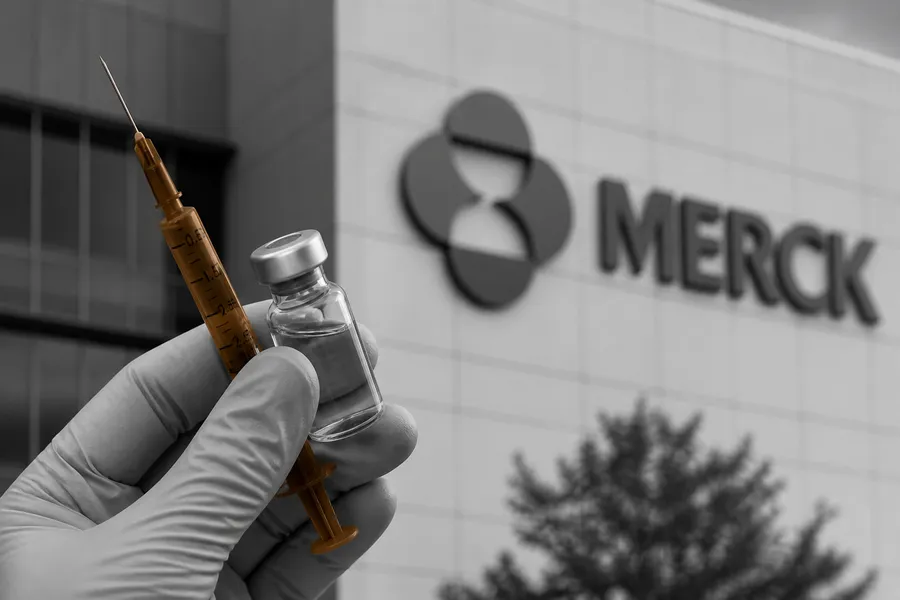
Hilleman Laboratories, the Singapore-based Merck (MRK) and Wellcome joint venture, is preparing to manufacture clinical-trial doses of an experimental Bundibugyo-strain Ebola vaccine as the Democratic Republic of Congo outbreak surpasses 1,000 deaths with no approved treatment available.
For investors tracking Merck’s global-health pipeline, the move signals an escalating commitment to Ebola response infrastructure – underscoring both reputational stakes and longer-term positioning in emerging-market vaccine supply chains where competitors have limited footholds.
Key Takeaways
- No approved vaccine exists for the Bundibugyo Ebola strain driving the Congo outbreak.
- Hilleman Labs – a Merck-Wellcome JV – will manufacture doses for clinical trials.
- Congo’s confirmed Ebola cases have reached 2,536, with deaths exceeding 1,000.
Market Context & Competitive Landscape
Merck’s existing WHO-prequalified Ebola vaccine, Ervebo, targets only the Zaire ebolavirus species and was shown to exceed 95% efficacy in trials, with an overall field effectiveness of 84% 1. The current Congo outbreak, however, is driven by the Bundibugyo species, for which neither Ervebo nor any other approved product offers protection – a gap that leaves public-health authorities relying solely on surveillance and risk-communication measures.
Oxford University scientists are separately developing a Bundibugyo-targeting candidate using the same adenovirus-vector platform deployed during the Covid-19 pandemic, with that programme potentially entering trials within months, according to Reuters 2. Hilleman’s manufacturing push positions the Merck-Wellcome vehicle as a rival clinical-supply node in what is rapidly becoming a multi-party race.
Deal Architecture & Strategic Rationale
Hilleman Laboratories was established as a joint venture between Merck and the global health charity Wellcome specifically to tackle vaccine-access problems in low- and middle-income countries. The entity is already embedded in Merck’s broader Ebola strategy: a January 2026 Reuters report confirmed that Merck’s MSD unit tapped Hilleman to develop an updated version of Ervebo under a $30 million programme co-funded by the Coalition for Epidemic Preparedness Innovations (CEPI), alongside SK bioscience and IDT Biologika on drug-substance manufacturing 3.
That earlier CEPI deal targeted yield improvements and extended shelf life for Ervebo to cut costs for public-sector buyers in developing markets. The new Bundibugyo manufacturing mandate expands Hilleman’s role from reformulation work into first-in-class clinical-supply production – a materially different and higher-risk undertaking.
Why the Bundibugyo Gap Matters to the Investment Case
Wellcome has been explicit about the structural problem: both currently approved Ebola vaccines address only the Zaire species, leaving other strains – including Bundibugyo – without an approved countermeasure and dependent on public-health containment alone 1. With Congo’s confirmed case count at 2,536 and deaths surpassing 1,000 as of late July 2026, the humanitarian pressure to accelerate a clinical programme is acute 3.
For Merck shareholders, successful clinical-trial dosing of a Bundibugyo candidate would extend the company’s Ebola intellectual-property perimeter beyond the Zaire-only Ervebo franchise – potentially unlocking new procurement contracts with CEPI, Gavi, and government stockpile buyers in future outbreaks.
Management Signal
“Other vaccine candidates that target non-Zaire species are in development but require sustained global funding and country-approved strategies to assess novel vaccines during outbreaks,” Wellcome said in a published assessment of the Ebola landscape. “Otherwise, any approved vaccines could remain inaccessible to the communities most affected.” 1
The statement underscores that manufacturing readiness – not just scientific discovery – is the critical rate-limiting step, which is precisely the capability Hilleman brings to the partnership.
Conclusion
Hilleman Laboratories’ clinical manufacturing mobilisation for a Bundibugyo Ebola vaccine represents a tangible pipeline catalyst for Merck, extending its Ebola franchise into an unaddressed strain category at a moment of acute outbreak pressure. Deal-focused investors should monitor whether CEPI or Wellcome attach formal funding commitments to the Bundibugyo programme – a trigger that would sharpen the timeline and de-risk the clinical-supply investment for MRK.
Not investment advice. For informational purposes only.
References
1(Apr 17, 2025). “Ebola vaccine: transforming global health responses”. Wellcome. Retrieved July 30, 2026.
2(May 26, 2026). “Oxford University scientists are developing a new Ebola vaccine”. Business Insider Africa / Reuters. Retrieved July 30, 2026.
3Reuters (Jan 21, 2026). “Merck unit partners with global health coalition to develop affordable Ebola vaccine”. Reuters. Retrieved July 30, 2026.
4(Nov 24, 2014). “Merck and NewLink Genetics Enter Into Licensing and Collaboration Agreement for Investigational Ebola Vaccine”. Merck.com. Retrieved July 30, 2026.
5(Nov 24, 2014). “NewLink, Merck deal boosts prospects for Ebola vaccine”. CIDRAP. Retrieved July 30, 2026.